


“`html
Choosing a new boiler is one of the most important decisions you can make for your home’s heating and hot water system. The right boiler can improve comfort, reduce energy bills and provide reliable performance for years.
One of the most common questions we hear at All Plumbing Services is: combi boiler vs system boiler, which one should I choose?
The answer depends on factors such as your home’s size, the number of bathrooms, your household’s hot water demand and any future plans for the property.
In this guide, we explain the difference between combi and system boiler options in simple terms. We compare how they work, look at the advantages and disadvantages of each system and help you decide which boiler is best suited to your household.
Understanding the Different Types of Boilers
Before comparing a combi boiler and a system boiler, it helps to understand the main boiler types available.
Combi Boiler
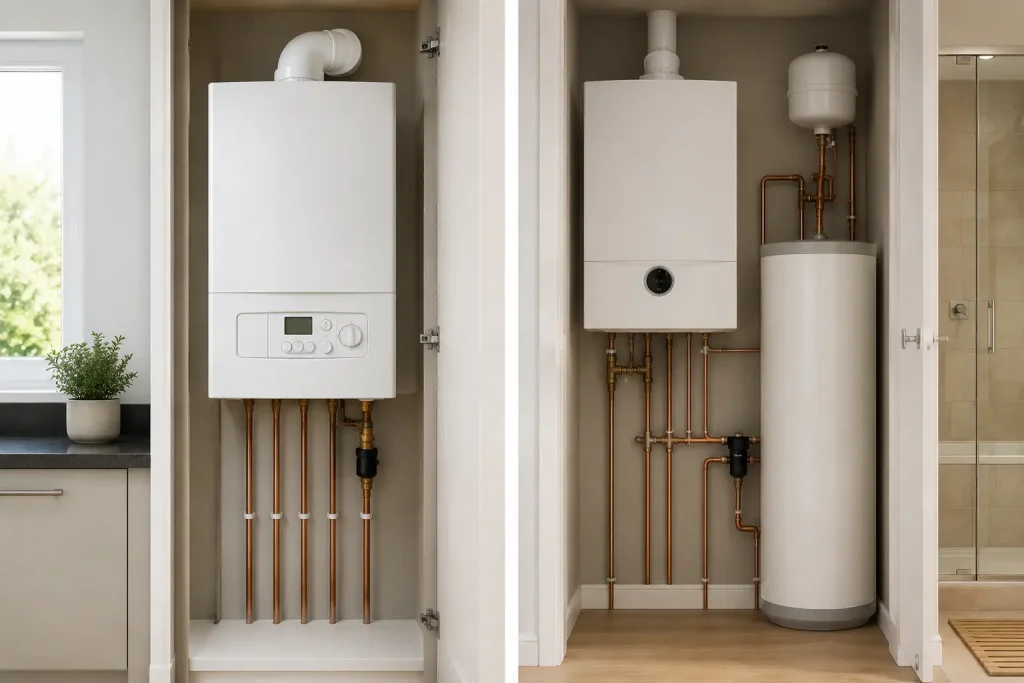
A combination boiler, usually called a combi boiler, provides both heating and hot water directly from one unit. It heats water only when needed and does not require a separate hot water cylinder.
System Boiler
A system boiler works alongside a hot water cylinder. It stores hot water so it can be supplied to multiple taps and showers at the same time.
Conventional Boiler
A conventional boiler uses both a hot water cylinder and a cold water storage tank. These systems are commonly found in older properties.
For most modern homes, the decision usually comes down to a combi boiler or a system boiler.
Combi Boiler vs System Boiler: What Is the Main Difference?
The biggest difference is how hot water is supplied.
| Feature | Combi Boiler | System Boiler |
|---|---|---|
| Hot water storage | No | Yes |
| Hot water cylinder required | No | Yes |
| Space required | Minimal | More space needed |
| Multiple showers at once | Limited | Better suited |
| Installation complexity | Simpler | More complex |
| Hot water availability | On demand | Stored and ready |
A combi boiler heats water instantly when you turn on a tap. A system boiler heats and stores water in a cylinder so it is available when needed.
Why Is This Decision Important?
Your boiler affects everyday comfort, heating performance and energy efficiency.
Choosing the wrong system can lead to poor hot water performance, unnecessary energy use and higher running costs.
The best boiler for your home depends on your household size, property layout and hot water demand.
Combi Boiler Benefits
Combi boilers are one of the most popular heating systems in UK homes.
Compact Design
Because there is no need for a hot water cylinder, combi boilers help save valuable space.
Hot Water on Demand
Water is heated only when needed, eliminating the need to store hot water.
Lower Installation Costs
Fewer components and less pipework can make installation more affordable.
Energy Efficient Operation
Modern combi boilers are highly efficient and can help reduce energy waste.
Ideal for Smaller Properties
Combi boilers work particularly well in flats, apartments and smaller houses.
Combi Boiler Pros and Cons
Pros
- Space-saving solution
- Lower upfront installation costs
- Efficient operation
- Less pipework required
- Suitable for small and medium-sized homes
Cons
- Can struggle when multiple taps are used simultaneously
- Water pressure may reduce during peak demand
- Not always ideal for large families
- Dependent on mains water pressure
System Boiler Benefits
System boilers are often preferred in larger households where hot water demand is higher.
Reliable Hot Water Supply
Stored hot water allows multiple outlets to be used at the same time.
Better for Multiple Bathrooms
Several showers and taps can run simultaneously with less impact on performance.
Consistent Water Pressure
System boilers can provide a more consistent hot water experience in larger homes.
No Loft Tank Required
Unlike conventional systems, a loft-based cold water storage tank is not needed.
Suitable for High Demand Households
Families with higher hot water usage often benefit from a system boiler setup.
System Boiler Pros and Cons
Pros
- Excellent for larger properties
- Supports multiple bathrooms
- Consistent hot water supply
- Works well for busy family homes
- Suitable for high demand periods
Cons
- Requires space for a hot water cylinder
- Installation costs can be higher
- Stored water can eventually run out
- More components than a combi system
Which Is Better: Combi or System Boiler?
Many homeowners ask, “Which is better, combi or system boiler?”
There is no universal answer because every home is different.
The better option depends on your property size and how your household uses hot water.
A Combi Boiler May Be Best If:
- You live in a flat or smaller house
- You have one bathroom
- Storage space is limited
- Your household has lower hot water demand
- You want a straightforward installation
A System Boiler May Be Best If:
- You have multiple bathrooms
- Several people use hot water at the same time
- You have a larger family
- Your home has higher hot water demand
- You want stronger performance during busy periods
Best Boiler for a Small House
For many smaller homes, a combi boiler is often the most practical choice.
Because there is no cylinder, valuable storage space is preserved. Hot water is produced only when needed, which can help improve efficiency.
If your property has one bathroom and average daily hot water usage, a combi boiler is usually the preferred option.
Best Boiler for a Family Home
When choosing the best boiler for a family home, hot water demand becomes a much bigger consideration.
If multiple family members use showers during the morning rush or several bathrooms are used at the same time, a system boiler often provides a better experience.
A stored supply of hot water helps meet higher demand without noticeable reductions in performance.
Energy Efficient Boiler Options
Modern combi and system boilers are both highly efficient when installed correctly.
The most energy efficient boiler options are usually modern condensing boilers. These systems recover additional heat that would otherwise be wasted.
The key factor is choosing a boiler that is properly sized for your property.
An oversized boiler may waste energy. An undersized boiler may struggle to meet demand.
This is why professional assessment is important before installation.
Real World Examples
Example 1: Small Household
Imagine a couple living in a two-bedroom house with one bathroom.
They rarely use multiple hot water outlets at the same time and want to free up cupboard space.
In this situation, a combi boiler would likely provide everything they need while keeping installation costs lower.
Example 2: Growing Family
Now consider a family of five living in a four-bedroom property with two bathrooms.
Morning routines often involve several showers, taps and appliances using hot water at the same time.
A system boiler with a suitable cylinder would generally provide a more comfortable and reliable solution.
Boiler Replacement Guide: Questions to Ask Before Choosing
Before replacing your boiler, consider the following questions:
- How many bathrooms does your home have?
- How many people live in the property?
- Do multiple showers run at the same time?
- Is storage space limited?
- What is your current boiler type?
- Are you planning future home improvements?
The answers will usually indicate whether a combi boiler or a system boiler is the better fit.
Common Mistakes When Choosing a Boiler
Choosing Based Only on Installation Cost
A cheaper installation does not always provide the best long-term value.
Ignoring Household Demand
Choosing a combi boiler for a high-demand household can lead to performance issues.
Overlooking Available Space
System boilers require room for a hot water cylinder.
Not Planning for the Future
Household size and hot water requirements can change over time.
Selecting Based Only on Price
The right boiler should be chosen for performance and suitability, not just upfront cost.
Combi Boiler vs System Boiler: Final Verdict
There is no single winner when comparing combi boilers and system boilers.
Choose a combi boiler if:
- Your home is small to medium-sized
- You have one bathroom
- Space is limited
- Hot water demand is moderate
Choose a system boiler if:
- Your home is larger
- You have two or more bathrooms
- Several people use hot water simultaneously
- You need stronger hot water performance
Both options can provide excellent comfort, efficiency and reliability when correctly specified and installed.
How Your Heating System Affects Your Home
Your boiler works alongside other heating and plumbing components to keep your home comfortable.
When replacing a boiler, it is worth considering the condition of your radiators, controls and overall heating system to maximise efficiency.
A complete assessment helps ensure every part of the system works together effectively.
- A combi boiler provides heating and hot water directly from one unit.
- A system boiler stores hot water in a cylinder.
- Combi boilers save space and suit smaller households.
- System boilers are ideal for larger homes with higher demand.
- The best choice depends on your property and lifestyle.
- Professional sizing and installation are essential for efficiency.
Frequently Asked Questions
What is the difference between a combi and system boiler?
A combi boiler heats water on demand without storing it. A system boiler stores hot water in a cylinder for later use.
Is a combi boiler cheaper to install?
In many cases, yes. Combi boilers often require fewer components and less pipework.
Can a combi boiler run two showers at once?
Some larger combi boilers can manage this, but performance may vary depending on water pressure and demand.
Are system boilers more efficient?
Modern system boilers can be highly efficient. Efficiency depends more on correct sizing, installation quality and usage patterns than boiler type alone.
How long does a new boiler last?
A quality boiler that is properly maintained can often last between 10 and 15 years or more.
Need Help Choosing the Right Boiler?
At All Plumbing Services, we assess your property’s size, hot water requirements and heating needs before recommending a solution. Our goal is to help you choose a boiler that delivers reliable performance, energy efficiency and long-term value.
“`